Can an Automatic Cat Feeder Help When You're Away?
An automatic cat feeder dispenses pre-set portions of dry food at scheduled times, helping maintain a cat's regular feeding routine when its owner is briefly away. Depending on the model, it may also offer remote feeding, feeding records, and battery backup. However, it cannot replace human supervision or daily pet care.
- Scheduled FeedingProgram meal times in advance so food is dispensed automatically.
- Portion ControlSet the amount released at each meal, depending on the feeder's settings and food compatibility.
- Smart ControlSelected Wi-Fi models support remote feeding and schedule adjustments through a mobile app.
- Power BackupSome models support battery backup to maintain scheduled dispensing during a temporary power interruption.
1. What Is an Automatic Cat Feeder?
An automatic cat feeder is a device designed to dispense dry pet food according to a programmed feeding schedule. It helps manage when food is released and, depending on the model, how much is dispensed at each meal.
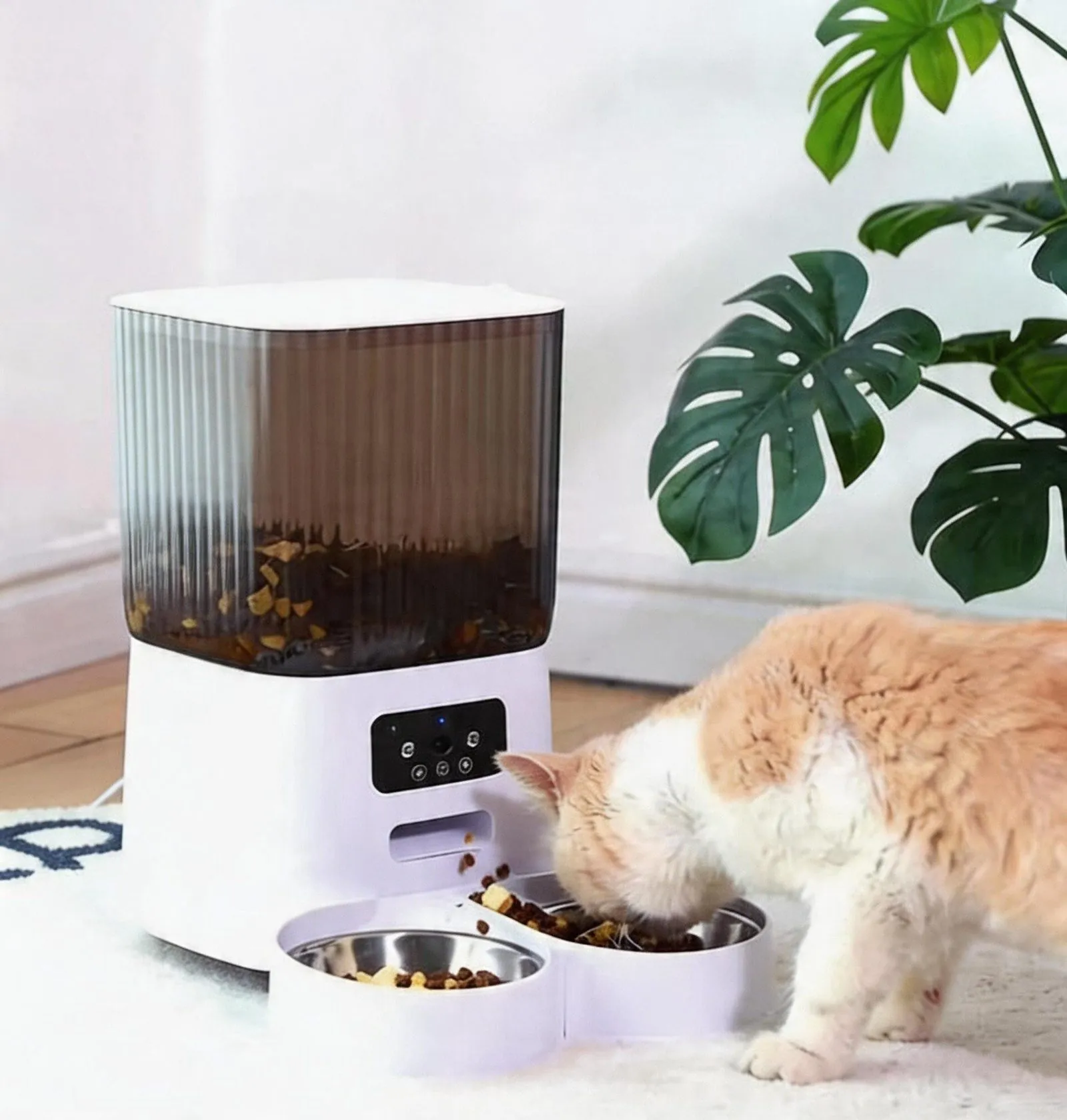
Most hopper-style automatic cat feeders contain four main components:
- Food Storage Hopper: Holds dry cat food before dispensing.
- Dispensing Mechanism: Releases food using a motor-driven system or another feeding mechanism.
- Control System: Stores feeding schedules and manages dispensing operations.
- Food Bowl: Collects the dispensed food for the cat.
When a scheduled feeding time arrives, the control system activates the dispensing mechanism and releases a pre-set amount of food into the bowl. Unlike a traditional food bowl, an automatic feeder can distribute meals according to a programmed schedule without requiring the owner to release every meal manually.
Two Common Types of Automatic Cat Feeders
1. Programmable Automatic Cat Feeders
These models use built-in buttons, a display, or a control panel to set feeding times and portion sizes. Some models store their feeding schedules directly in the device and can continue operating without an internet connection, provided they have power.
2. Smart Wi-Fi Automatic Cat Feeders
Smart models connect to a mobile app, allowing owners to manage selected feeding functions remotely. Depending on the product, additional features may include feeding history, device notifications, voice recording, or a built-in camera.
Most conventional hopper-style feeders are designed for dry kibble. Wet food requires a different storage and dispensing design, so buyers should check the manufacturer's stated food compatibility.
2. How an Automatic Cat Feeder Helps Maintain a Feeding Routine
Cats often become accustomed to eating at particular times. When owners are away, an automatic cat feeder can help maintain a familiar meal schedule.
Scheduled Feeding Without Manual Operation
Once the feeding schedule has been programmed, the feeder activates its dispensing mechanism at the selected times. For example, a daily feeding plan might include:
| Feeding Time | Scheduled Meal |
|---|---|
| 7:00 AM | Breakfast |
| 12:00 PM | Midday Meal |
| 6:00 PM | Dinner |
| 10:00 PM | Evening Meal |
One important detail is whether the feeder stores its schedule locally or relies on an internet connection. A locally stored schedule may continue operating during a temporary Wi-Fi outage, provided the device still has power. However, remote app control and online notifications may become unavailable.
Portion Control and Feeding Consistency
A good automatic cat feeder should allow owners to manage both feeding times and the amount of food dispensed. This can help establish a more structured feeding routine, especially for cats that need controlled meal portions.
One programmed portion does not have a universal gram value across all automatic cat feeder models. The actual weight of each portion depends on the dispensing mechanism and the size, shape, and density of the kibble.
Two types of cat food may occupy the same volume but have different weights. A feeder's portion settings should therefore be tested using the actual food types recommended for that product. Repeated weighing provides more useful information about dispensing consistency than simply stating that a feeder has 10 or 20 portion settings.
3. What to Look for When Choosing an Automatic Cat Feeder
Not every automatic cat feeder is suitable for every household. Food capacity, dispensing reliability, power options, and cleaning requirements all affect the user experience. Before choosing a model, consider the following factors.
3.1 Food Capacity and Storage Design
Food hopper capacity is commonly measured in liters or cups. However, volume does not directly indicate how many grams of cat food the feeder can hold. Different kibble types have different densities, so the actual food weight may vary.
A useful product specification should include:
- Hopper capacity in liters.
- Approximate food weight based on a specified kibble type.
- Recommended kibble size range.
- Maximum filling level.
- Lid design and food-storage structure.
A removable hopper or lid can also make refilling and cleaning more convenient. For households with multiple cats, buyers should consider whether the feeder's capacity and dispensing design are appropriate for the number of pets and their feeding requirements.
3.2 Reliable Food Dispensing Mechanism
The dispensing mechanism is one of the most important components of an automatic cat feeder. If kibble becomes stuck in the outlet, a scheduled meal may not be released correctly.
Food size, shape, crumbs, and moisture can all affect dispensing performance. A reliable design should be evaluated using different approved dry food types rather than a single sample.
A feeder may dispense smoothly when the hopper is full but behave differently when the remaining food level becomes low. Testing at both high and low fill levels can help reveal potential dispensing problems.
Buyers should check whether the manufacturer has evaluated:
- Different approved kibble sizes and shapes.
- Full and partially filled hoppers.
- Repeated dispensing cycles.
- Potential food blockages.
- Portion consistency across repeated operations.
3.3 Power Supply and Battery Backup
Most automatic pet feeders use an external power adapter. Some models also include a battery compartment for backup power. Battery backup can help maintain scheduled dispensing during a temporary power interruption, but buyers should not assume that all functions remain available.
For example, battery backup may keep scheduled dispensing working while Wi-Fi control becomes unavailable because the home router has lost power.
Before purchasing, confirm:
- Whether backup batteries are supported.
- Which battery type is required.
- Whether scheduled feeding continues during a power interruption.
- Whether the feeding schedule is retained after restarting.
- Whether the app reconnects automatically after power is restored.
The product manual should clearly explain the behavior of each function during power interruptions.
3.4 Easy Cleaning and Everyday Maintenance
Food-contact components should be easy to remove and clean. A practical design may include a detachable food bowl, removable food hopper, accessible dispensing outlet, and a lid that can be opened for refilling and maintenance.
Manufacturers should provide clear cleaning instructions, especially for components containing motors or electronic parts. Washable components should be completely dry before reassembly. Electronic components and motor assemblies should not be immersed in water unless the manufacturer explicitly states that they are designed for it.
Most conventional automatic cat feeders are intended for dry food. They should not be promoted for wet food unless the product has been specifically designed and tested for that use.
3.5 Product Reliability and Manufacturing Quality
A good-looking sample does not automatically guarantee consistent mass production. For buyers comparing automatic pet feeder suppliers, it is important to understand how the manufacturer controls key components and verifies product performance.
Useful information to request includes:
- A working product sample and detailed specification sheet.
- Portion dispensing test records and kibble compatibility information.
- Power and battery backup test results.
- Applicable compliance documentation.
- Packaging, labeling, production lead time, and quality-control arrangements.
For customized products, the approved sample, bill of materials, firmware version, and agreed testing requirements should be documented before mass production. Changes to the motor, control board, power adapter, dispensing structure, or firmware may affect performance even if the external appearance remains unchanged.
4. Smart Features That Make Remote Cat Feeding More Convenient
A standard automatic feeder can dispense scheduled meals. A smart automatic cat feeder adds app-connected features that make feeding management more flexible. The available functions vary by model.
4.1 Remote Feeding Through a Mobile App
Some Wi-Fi automatic cat feeders allow owners to manage selected feeding functions through a smartphone app. Supported functions may include creating or adjusting feeding schedules, changing selected portion settings, triggering an additional meal remotely, viewing feeding records, and receiving device-status notifications.
Remote control can be useful when plans change or owners need to adjust a scheduled feeding time while away. However, app compatibility should be checked before purchasing. Many Wi-Fi pet products use 2.4 GHz networks, but buyers should confirm the actual wireless requirements of the selected model.
Other details worth checking include mobile operating-system support, app languages, account registration requirements, and software maintenance arrangements.
4.2 Feeding Records and Device Notifications
Selected smart feeders can display feeding records or send notifications when the food level is low or a device-related issue occurs. These functions help owners understand the operating status of their feeder.
4.3 Optional Camera and Voice Functions
Some premium automatic pet feeders include a camera, microphone, speaker, or voice-recording function. A camera allows owners to view the feeding area remotely, while a voice function may play a recorded message around mealtime.
Before choosing a model with additional smart functions, consider camera resolution and viewing angle, night vision performance, microphone and speaker quality, mobile app compatibility, video storage options, and privacy and data-handling arrangements.
More functions do not always make a product better. Buyers should consider whether the additional features provide meaningful value for their household or target market.
5. How to Prepare an Automatic Cat Feeder Before a Trip
Even a well-designed automatic cat feeder needs proper setup before departure. Owners should test the device under normal household conditions rather than waiting until the last minute.
- Program the feeding schedule.
Set feeding times and portion sizes several days before leaving. Check that the correct schedule is stored in the device and that its clock displays the correct time. - Test the actual cat food.
Use the same dry food that will be stored in the hopper during the trip. Run several dispensing cycles and observe the output. Weighing the dispensed food can help you understand whether the portion settings are suitable for that particular kibble. Recheck the settings when changing to a different type of food. - Check the power supply and app.
Make sure the power adapter is connected securely. For smart models, test the app connection, remote feeding function, and available notifications. If battery backup is supported, install the specified batteries and follow the manufacturer's instructions. - Clean and refill the hopper.
Remove old food crumbs and clean detachable components according to the product manual. Make sure washable parts are completely dry before refilling the hopper. Avoid filling above the manufacturer's recommended level. - Run a trial under normal conditions.
As a practical precaution, operate the feeder for several consecutive days before relying on it during a trip. Observe whether scheduled meals are dispensed correctly, whether the food moves smoothly, and whether your cat is comfortable eating from the bowl. - Arrange human care and fresh water.
An automatic feeder should not be the only care arrangement for a cat while its owner is away for an extended period. Make sure fresh drinking water is available separately and arrange for a trusted person or pet sitter to check on your cat.
The suggested trial period is a practical precaution, not a formal industry standard or veterinary recommendation.
6. Can an Automatic Cat Feeder Replace a Pet Sitter?
No. An automatic cat feeder can manage scheduled food dispensing, but it cannot replace human supervision and personal care.
It cannot check whether a cat is sick or injured, respond to an unexpected health problem, clean the litter tray, refill drinking water when needed, provide physical attention, or identify problems that require immediate action.
An automatic cat feeder should therefore be treated as a feeding aid rather than a complete pet-care solution.
The UK animal welfare charity PDSA recommends that cats should not be left without someone checking on them at least a couple of times a day when their owners go on holiday, even if an automatic feeder or cameras are available. PDSA also recommends that cats have company overnight.
Source: PDSA – What to Do with Your Cat When You Go on Holiday.
Every cat has different needs. Kittens, senior cats, cats with medical conditions, and cats requiring medication may need more frequent or specialized care. Owners should discuss suitable arrangements with their veterinarian when necessary.
What This Means for Pet Product Buyers and Brands
For pet product brands, wholesalers, and distributors, this is also an important product-positioning consideration. An automatic cat feeder should be marketed around realistic benefits:
- Helping maintain scheduled meals.
- Providing adjustable portion settings.
- Supporting remote feeding on compatible models.
- Reducing the need for manual food dispensing at every mealtime.
Responsible product descriptions help build customer confidence and reduce complaints caused by unrealistic expectations.
7. Automatic Cat Feeder Quality Evaluation: What Should Buyers Test?
Product specifications should be supported by actual measurements or documented functional tests. Since automatic cat feeders vary in design, there is no single technical specification or testing target that applies to every model. The following table provides a practical evaluation framework for manufacturers, importers, and distributors.
Automatic Cat Feeder Quality Evaluation Checklist
| Test Item | What to Measure or Check | Suggested Verification |
|---|---|---|
| Hopper Capacity | Volume in liters and food weight in grams | Test using a specified kibble type |
| Portion Accuracy | Actual food weight per dispensing setting | Weigh repeated dispensing cycles |
| Dispensing Reliability | Missed, blocked, or double dispensing | Run repeated dispensing cycles |
| Kibble Compatibility | Suitable food size and shape | Test different approved kibble types |
| Power Backup | Feeding behavior during power interruption | Test power disconnection and recovery |
| Wi-Fi Compatibility | Supported network and app functions | Verify actual router requirements |
| Cleaning | Removable and washable components | Follow the cleaning instructions |
| Production Consistency | Repeatability between units and batches | Inspect against an approved sample |
Important: The number of test cycles and acceptable performance limits should be agreed upon by the buyer and manufacturer. Any suggested internal screening procedure is a testing proposal, not a universal industry standard.
A Practical Portion Accuracy Test
- Select a dry food type within the manufacturer's recommended size range.
- Fill the hopper to the specified test level.
- Set one dispensing level.
- Collect and weigh the food from at least 10 consecutive dispensing cycles.
- Calculate the average output and record the variation.
- Repeat at a lower hopper fill level.
- Repeat with other approved kibble types.
The test report should identify the feeder model, food type, hopper fill level, dispensing setting, sample count, average output, and observed variation. For buyers, receiving actual test conditions and results is more valuable than seeing a general claim such as “high-precision feeding.”
OEM/ODM Customization and Manufacturing Considerations
For private-label buyers, customization may involve more than printing a logo.
| Area | Possible Customization |
|---|---|
| Appearance | Housing color, finish, and logo placement |
| Food Storage | Hopper capacity and lid design |
| Feeding System | Portion settings and dispensing structure |
| Smart Functions | App branding and selected software functions |
| Power | Adapter specifications and backup battery options |
| Packaging | Retail box, multilingual manuals, and private-label artwork |
Changes to the motor, electronics, dispensing mechanism, or software may require engineering validation and additional development time. Before mass production, both parties should confirm the approved design, bill of materials, firmware version, testing procedure, packaging artwork, and quality acceptance criteria.
8. Frequently Asked Questions About Automatic Cat Feeders
Can an automatic cat feeder work without Wi-Fi?
Some models store feeding schedules locally and can continue dispensing without Wi-Fi, provided they have power. Remote app control and online notifications may not work during an internet outage. Check the selected model's specifications.
How accurate are automatic cat feeder portion sizes?
Portion accuracy depends on the dispensing mechanism and the kibble type. Different food shapes and densities may produce different weights. Manufacturers should verify portion output through repeated weighing tests using approved food types.
Can I use wet food in an automatic cat feeder?
Most standard hopper-style automatic cat feeders are designed for dry kibble. Wet food should only be used in products specifically designed for wet-food storage and dispensing.
Does an automatic cat feeder have battery backup?
Some models include a battery backup compartment, while others rely entirely on an external power adapter. Buyers should confirm whether scheduled dispensing continues during a power interruption and which functions remain available.
Can an automatic cat feeder replace a pet sitter?
No. An automatic cat feeder can manage scheduled food dispensing, but it cannot monitor a cat's overall health or provide personal care. Owners should arrange appropriate human supervision when they are away.
How long should I test an automatic cat feeder before a trip?
A practical precaution is to operate the feeder for several consecutive days under normal household conditions before leaving. Test the actual cat food, scheduled dispensing, power supply, and app functions where applicable.
What should wholesalers check before ordering automatic cat feeders?
Wholesalers should evaluate sample quality, portion consistency, kibble compatibility, power options, app functions, compliance documentation, packaging, production lead time, and quality-control procedures. OEM/ODM requirements should be agreed upon before mass production.
Looking for an Automatic Cat Feeder Manufacturer?
Choosing an automatic cat feeder involves more than comparing product features. Consistent dispensing performance, stable components, clear specifications, and dependable production support all matter when developing a successful pet product business.
Lumotix works with pet brands, wholesalers, and distributors on automatic pet feeder sourcing and OEM/ODM projects. Depending on the selected model and engineering requirements, customization may include housing colors, logo placement, packaging, selected feeding functions, and private-label presentation.
Product functions vary by model. Always refer to the selected product's specifications and user manual for supported food types, dispensing settings, app functions, and backup-power behavior.